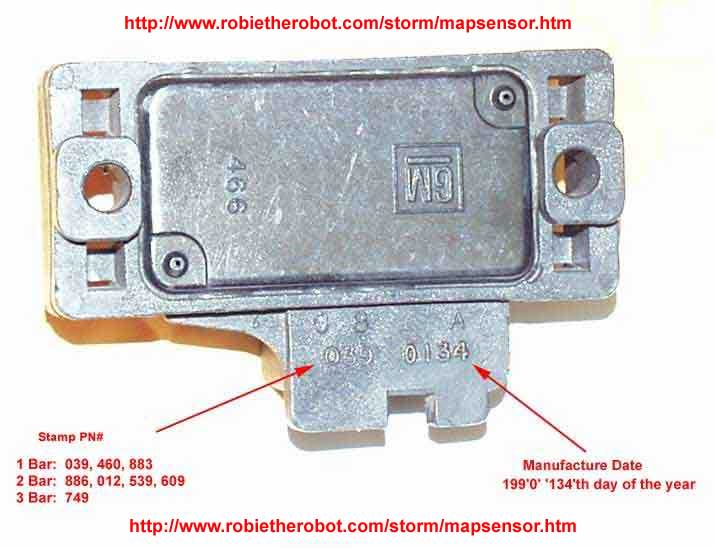
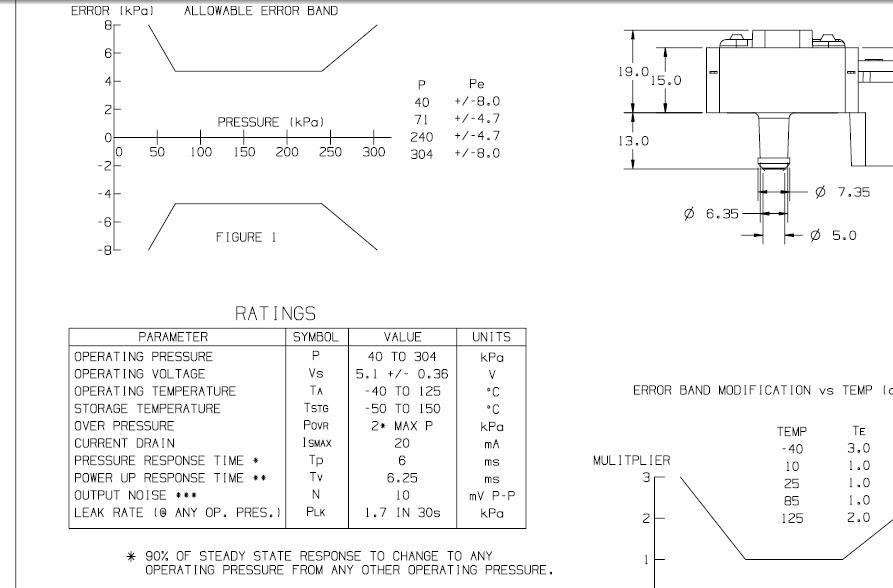
I once got ripped off by ordering a 3Bar MAP sensor from some idiot on Ebay---he actually sent me a 1BAR! So....to make sure it didn't happen again, I did some research on how to identify a GM MAP sensor.
3 digit numbers for identification: 1 Bar: 039, 460, 883, 876, 153 2 Bar: 886, 012, 539, 609, 701 3 Bar: 749, 861
Believe in Karma? Donate!
The logic module uses the manifold absolute pressure (MAP) sensor to determine the absolute pressure (not the relative to atmospheric pressure) of the air inside the intake manifold and the atmosphere (barometric pressure). This information is used to determine the density of the air entering the combustion chamber (in conjunction with the IAT(Intake Air temperature) sensor), which is used when calculating the proper air/fuel mixture for the engine, especially at WOT since the system is not in closed-loop at this time. It is also used to help adjust the IAC(Idle Air Control) motor during idle.
It uses a silicon wafer that is thinner in the center (0.001") than around the edges (0.045"), which causes it to act as a diaphram. It is mounted with a perfect vacuum beneath the chip so that the air pressure from the other side flexes the chip. This flexing causes a change in resistance and the circuitry inside the sensor converts this to a voltage ranging from 0.02V to 4.94V when the output is pulled up towards 5V by the ECM(Electronic control module).
1 Bar MAP sensors are used on NA(naturally asperated) vehicles.
2 Bar MAP Sensors are used on forced induction vehicles(Turbo & Supercharged). They can measure up to 2x the apmospheric pressure(29.4psi), so that means it can measure up to 14.7psi boost(the atmosphere is 14.7psi + 14.7psi from the turbo/supercharger).
3 Bar MAP sensors can measure up to 44.1psi, which translates to 29.7psi boost from a Turbo/supercharger.
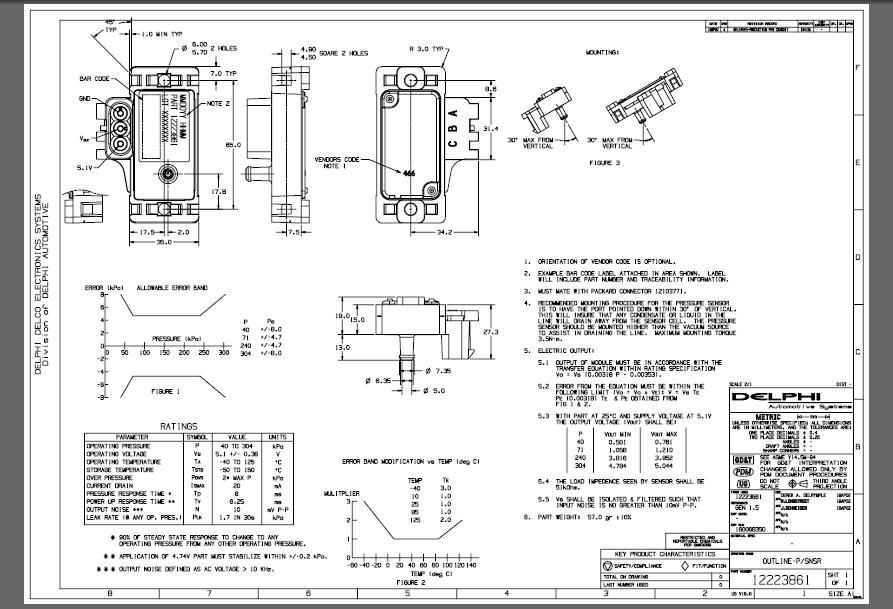
They all share a common pinout, although the connector keying may be different:
Pin A -- Ground
Pin B -- Sensor output
Pin C -- +5 volts
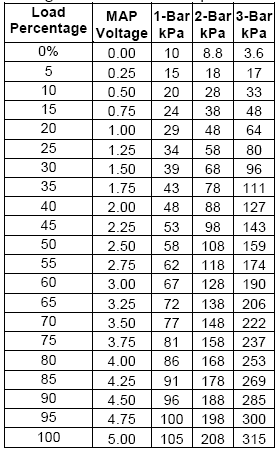
The chart below describes the pressure-to-voltage relationship of the stock GM Turbo MAP sensor (2 bar):
Manifold Pressure (relative sea level / absolute)
2 Bar MAP Output
14.31psi / 29.01psi
4.90V
14.00psi / 28.70psi
4.84V
13.00psi / 27.70psi
4.67V
12.00psi / 26.70psi
4.50V
11.00psi / 25.70psi
4.33V
10.00psi / 24.70psi
4.16V
9.00psi / 23.70psi
3.99V
8.00psi / 22.70psi
3.82V
6.00psi / 20.70psi
3.47V
4.00psi / 18.70psi
3.13V
2.00psi / 16.70psi
2.79V
0.00psi / 14.70psi
2.45V
5.00inHg / 12.24psi
2.03V
10.00inHg / 9.78psi
1.61V
15.00inHg / 7.33psi
1.19V
20.00inHg / 4.87psi
0.77V
25.00inHg / 2.41psi
0.35V
29.10inHg / 0.40psi
0.02V
MAP sensor output based on altitude (Ignition "ON" and engine stopped)
Altitude
Voltage Range
Meters
Feet
--------------
Below 305
Below 1000
3.8--5.5V
305--610
1000--2000
3.6--5.3V
610--914
2000-3000
3.5--5.1V
914--1219
3000--4000
3.3--5.0V
1219--1524
4000--5000
3.2--4.8V
1524--1829
5000--6000
3.0--4.6V
1829--2133
6000--7000
2.9--4.5V
2133--2438
7000--8000
2.8--4.3V
2438--2743
8000--9000
2.6--4.2V
2743--3048
9000-10000
2.5--4.0V
Low altitude = High Pressure = High Voltage
GM 1bar, 2bar, 3bar
1 PSI = 2.036" of Mercury (HG)
1" mercury = 0.4911541 PSI
Formula for the GM 3 Bar MAP sensor is (V*8.94)-14.53
I have no idea why it's 14.53 and not 14.696, [rounds up to 14.7] but it works out on GM's chart every time. It is possible that Detroit is slightly above sea level, and you can use 12.11 in the formula for 1 mile above sea level.
MAP Sensor CEL errors
On 1995 and newer vehicles with OBD II self-diagnostics, a DTC code P0105 through P0109 would indicate a fault in the MAP sensor circuit:
On older pre-OBD II vehicles, the MAP codes are:
* General Motors: Codes 34, 33, 31
* Ford: Codes 22, 72
* Chrysler: Codes 13, 14
On vehicles that provide data stream through a diagnostic connector and allow a scan tool to display sensor values, the MAP sensor's output voltage can be read and compared to specifications. Basically, you want to see a quick and dramatic change in the MAP sensor signal when the throttle on an idling engine is snapped open and shut. No change would indicate a sensor or wiring fault.
If the sensor is reading low or there is no reading at all, check for proper reference voltage to the sensor. It should be very close to 5 volts. Also check the ground connection. If the reference voltage is low, check the wiring harness and connector for looseness, damage or corrosion.
Scan tools that display OBDII data will also display a "calculated load value" that can be used to determine if the MAP sensor is working or not. The load value is computed using inputs from the MAP sensor, TPS sensor, airflow sensor and engine speed. The value should be low at idle, and high when the engine is under load. No change in the value, or a higher than normal reading at idle might indicate a problem with the MAP sensor, TPS sensor or airflow sensor.